

Of Form and Fancy
We thought we would add a little collection of pages to explain some of the forms, terms and the history that makes up the world of decorative plasterwork. Over time we hope it will become an eclectic collection of notes, thoughts and essays from which you can extract whatever takes your eye. We hope you'll enjoy and please feel free to contribute with any observations you may have or corrections you feel we need to make

The Acanthus Leaf: A Timeless Motif in Architecture and Decoration
Introduction
Few decorative motifs have enjoyed the longevity and versatility of the acanthus leaf. Originating in the Mediterranean and first immortalised in stone over 2,500 years ago, the acanthus leaf has adorned everything from ancient temples to modern wallpaper. Its journey through history is a testament to its adaptability, symbolic potency, and aesthetic appeal, making it a cornerstone of architectural and decorative practice and quite possibly the most famous leaf in the world.

Ancient Greek Origins
The acanthus leaf’s story begins in the 5th century BCE, during the height of the ancient Greek Empire. According to Roman architect Vitruvius, the motif was inspired by a poignant scene: Callimachus, a Greek sculptor, saw an acanthus plant growing around a basket placed on a young girl’s grave. The graceful curling of the leaves around the basket moved him to recreate the sight in stone, giving birth to the Corinthian order of classical architecture.
Greek architecture was defined by three principal orders: Doric, Ionic, and Corinthian. While Doric and Ionic columns were relatively austere, the Corinthian capital—thanks to Callimachus—introduced a lush, naturalistic element. The broad, scalloped leaves of the acanthus plant (Acanthus mollis) were stylised to convey both vitality and elegance. The earliest known Corinthian column dates to 450–420 BCE, at the Temple of Apollo Epicurius in Arcadia. In Greece, the Corinthian order was reserved for monuments and temples where grandeur was paramount.
Temple of Apollo Epicurius in Arcadia, Greece

Roman Perfection and Expansion
It was the Romans who truly embraced and perfected the acanthus motif. By the 1st century BCE, the Corinthian capital had become the preferred style for Roman temples, forums, and civic spaces. The Romans streamlined the form, standardised proportions, and multiplied the lushness of the acanthus leaves, making the motif a defining feature of their architectural language.
Roman architects didn’t stop at columns. The acanthus leaf appeared in stone sarcophagi, wooden furniture, and tile mosaics. Decorative friezes featured inventive shapes—scrolls, intertwined leaves, and mythological figures—demonstrating the motif’s adaptability. The Romans even created the composite order, merging the volutes of the Ionic with the exuberance of the Corinthian. As Roman culture spread, so did the acanthus motif, merging with local traditions and becoming a visual shorthand for Roman authority.
The temple of vesta, Tivoli
Medieval Transformation
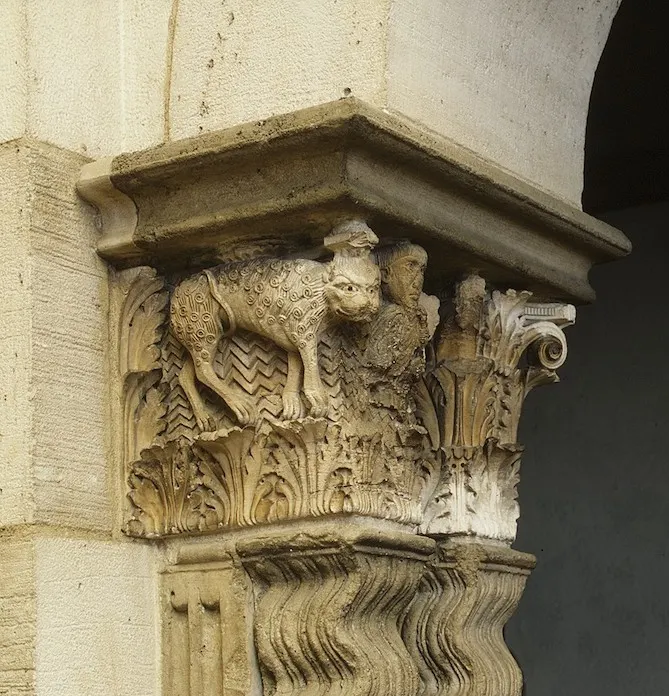
With the fall of Rome, the acanthus leaf was reborn in a Christian context. Medieval artisans reinterpreted the motif, shifting its meaning from imperial grandeur to spiritual struggle and salvation. In church stonework, such as the cloister of Saint-Guilhem-le-Désert Abbey, the acanthus became more angular and deeply cut, echoing the crown of thorns and symbolising Christ’s suffering.
The Byzantine tradition further evolved the motif, using it in lace-like capitals where the interplay of light and shadow suggested the tree of life. Illuminated manuscripts also featured acanthus borders, their curling tendrils guiding the reader’s eye and softening the motif’s lines. Through stone and parchment, medieval monks preserved the acanthus tradition, ensuring its survival through centuries of upheaval.
Column in the cloister of Saint-Guilhem-le-Désert Abbey
Renaissance Revival
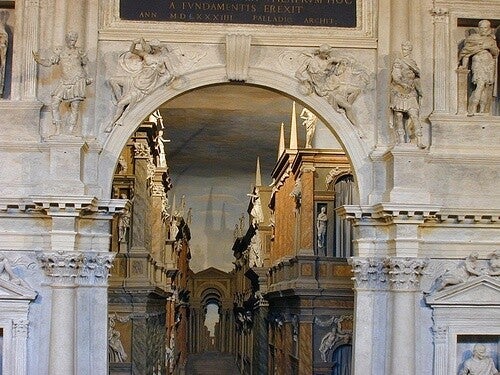
The Renaissance marked a return to classical ideals, and with it, a revival of the acanthus leaf. Italian masters, inspired by the rediscovery of Vitruvius’ De architectura, revitalised the motif as an emblem of rebirth and renewal. Acanthus ornaments flourished on palazzo façades, chapel interiors, marble doorframes, and choir stalls. The motif’s vitality and movement resonated with the Renaissance emphasis on harmony and classical beauty.
In the Villa Medici, ancient Roman acanthus friezes were incorporated into new designs, blending imitation with innovation. The acanthus leaf became a universal shorthand for classical refinement, a status it retained through the Baroque period and beyond.
Teatro Olimpico, Vicenza

Dutch Golden Age and Beyond
During the Dutch Golden Age (1575–1675), the acanthus leaf found new life in the homes of wealthy merchants, bankers, and civic leaders. Silverwork, furniture, and interior ornamentation featured acanthus motifs, symbolising enduring life and prosperity. The motif’s versatility allowed it to adapt to both the grandeur of civic halls and the intimacy of private homes.
The English also adopted the acanthus leaf, incorporating it into decorative and fine arts. Its presence in Dutch and English interiors illustrates how a motif rooted in antiquity could travel across borders and centuries, constantly reinvented to suit new audiences.
Amsterdam canal houses (gable stones and doorcases) 1600-1675

Symbolism and Significance
Throughout its history, the acanthus leaf has carried potent symbolism. In ancient Greece and Rome, it represented eternal life and worldly luxury. In medieval Christian art, it became a metaphor for suffering and salvation. In the Renaissance, it symbolised rebirth and the return to classical ideals. In modern times, it conveys beauty, cultural continuity, and sophistication.
Its adaptability is key to its enduring appeal. The acanthus leaf can be stylised or naturalistic, dramatic or delicate, monumental or intimate. It bridges the gap between nature and artifice, serving as a link between the organic world and human creativity. Whether carved in marble, painted on parchment, or woven into wallpaper, the acanthus leaf remains a powerful visual shorthand for elegance, tradition, and artistic excellence.
William Morris acanthus wallpaper

Conclusion
The acanthus leaf’s journey from ancient Greece to modern art is a story of transformation, adaptation, and enduring beauty. Its significance in architecture and decoration practice lies not only in its aesthetic qualities but also in its ability to convey complex meanings across cultures and eras. As a motif, it has survived the rise and fall of empires, religious shifts, and changing tastes, always finding new ways to express vitality and sophistication. In the world of design, the acanthus leaf stands as a testament to the power of tradition and the endless possibilities of artistic reinvention.